Saturday, October 24, 2026
* All product/brand names, logos, and trademarks are property of their respective owners.
When people think about safety in bags, outdoor gear, and apparel, they usually focus on visible elements: strong fabric, reinforced stitching, waterproof coatings, or heavy-duty zips. Yet in day-to-day use, it’s often the smaller components that determine whether a product feels secure or becomes a frustration. Ladderlocks are one of those components.
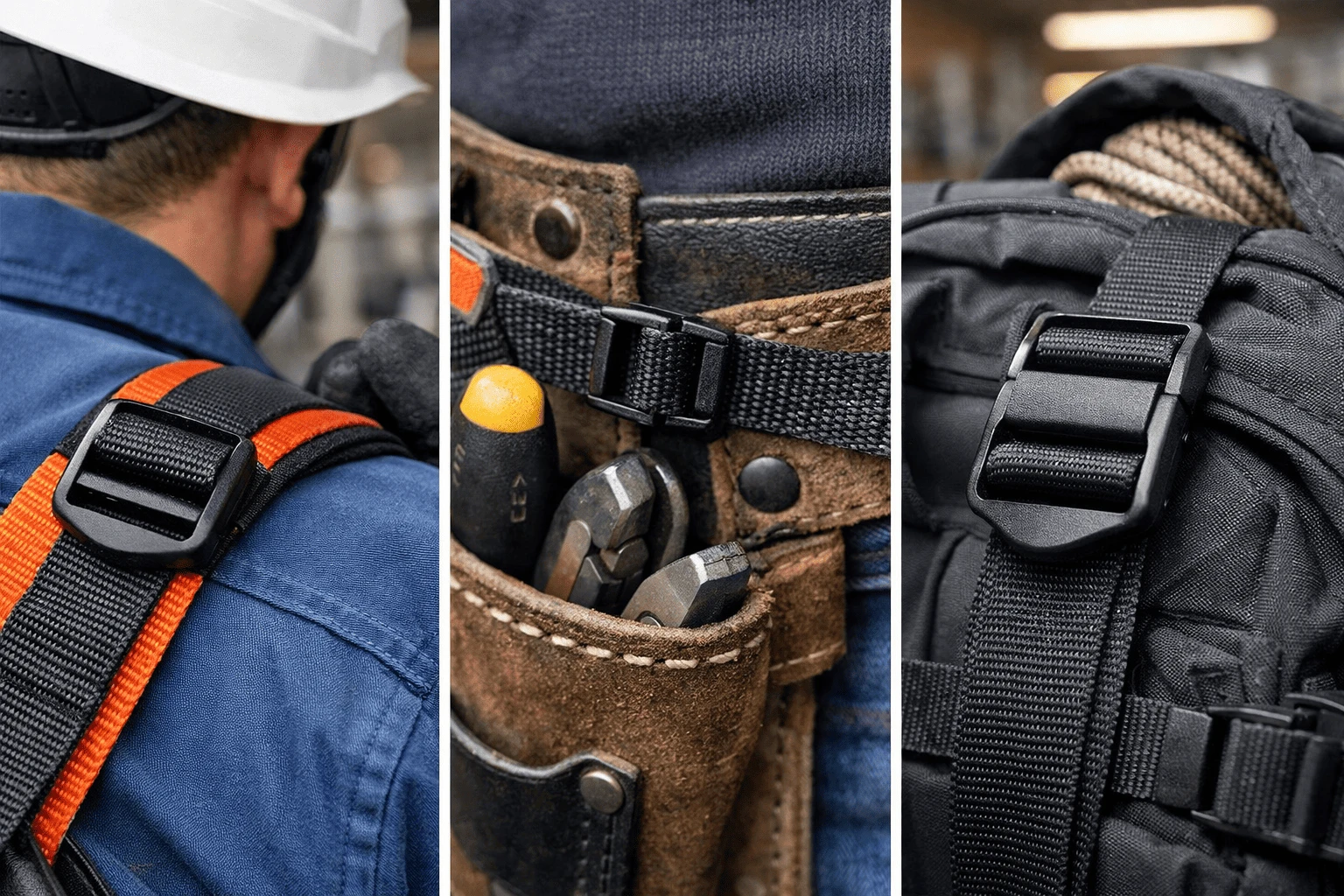
A ladderlock may look like a simple plastic strap adjuster, but it performs a critical function. It controls strap tension, locks webbing into position, and allows users to adjust fit quickly. If it slips, cracks, or loses grip, the entire product can feel unreliable. A backpack strap that slowly loosens during a walk or an outdoor strap that shifts under load quickly undermines user confidence. For UK manufacturers and buyers, the issue goes beyond convenience. Consistency, durability, and traceability matter. Selecting the correct ladderlock is not just a design decision — it is part of delivering a product that performs reliably in real-world conditions. This guide focuses on practical decision-making: understanding risks, selecting the correct size (15mm, 25mm, or 38mm), and carrying out straightforward UK-focused checks to support responsible sourcing.
Before choosing a size, it helps to start with one key question: what happens if the ladderlock underperforms?
Ladderlocks are responsible for holding tension. If the size, geometry, or material does not match the intended use, problems usually appear after the product reaches customers — which is when issues become expensive and reputationally damaging.
The most common failure is not dramatic breakage. It is gradual slipping, often referred to as “creep.”
Creep occurs when a strap slowly loosens under tension. At first, it may seem minor. Over time, however, repeated loosening becomes frustrating or even unsafe in load-bearing applications.
This typically happens when:
The ladderlock size does not properly match webbing width
The strap surface is too smooth for the grip design
Tension levels exceed what the size can handle
Strap routing reduces friction
Because ladderlocks rely on friction and geometry, even small mismatches can reduce holding strength. During prototyping, early warning signs include visible strap movement, the need for excessive tightening, or loosening after repeated adjustments.
Addressing these issues at selection stage prevents complaints later.
Another risk is fatigue. Ladderlocks experience repeated stress cycles as users tighten and loosen straps. Pressure concentrates around:
The central bar
Frame edges
Strap bend points
If the component is undersized or poorly matched to the load, stress builds over time, potentially leading to hairline cracks or deformation.
In UK conditions, seasonal temperature variation also matters. Plastics can behave differently in colder environments, particularly if already operating close to stress limits. A component that performs adequately in mild conditions may become brittle when exposed to cold.
Durability is therefore part of reasonable product expectation. Repeated-use reliability matters as much as initial performance.
Users do not always adjust straps carefully. They may:
Pull at sharp angles
Over-tighten aggressively
Adjust while walking
Use products in unintended ways
A marginally sized ladderlock leaves little tolerance for these behaviours. A correctly matched size provides greater stability and reduces the risk of slipping or cracking under imperfect handling. If straps twist, bunch, or require excessive force to feel secure, sizing should be reassessed. Correct matching eliminates many preventable problems.
Once risks are understood, selection becomes more structured. The decision should align with:
Strap width
Expected load and frequency of adjustment
Environment and user behaviour
For narrow webbing and controlled tension levels, a 15mm ladderlock often provides a clean and stable fit.
It is typically used in applications where straps are designed for positioning rather than heavy load-bearing. Because the webbing sits properly within the frame, friction is more predictable and twisting is reduced.
However, problems arise when 15mm components are chosen purely for aesthetic reasons while the strap must withstand repeated strong tension. If the strap functions as part of load control, creep becomes more likely.
Proper use means matching the size precisely to strap width and expected tension.
The 25mm size often offers a practical balance between stability and ease of use. It distributes force more effectively than narrower options without adding unnecessary bulk. For general-purpose bags, mid-weight outdoor gear, and frequently adjusted straps, this size provides a reliable grip. Ladderlocks are typically selected for their ability to maintain strap compatibility and consistent hold across repeated adjustments.
The 38mm size is generally used with wider webbing systems or in more demanding outdoor scenarios.
Wider webbing can distribute tension more evenly and reduce twisting. This can be particularly helpful when:
Gear shifts during movement
Straps are adjusted with gloves
Conditions include moisture, dirt, or cold
However, bigger is not automatically safer. If the strap does not require additional width, a 38mm ladderlock may introduce unnecessary bulk or snag risk. As with all sizes, correct matching to strap width and realistic load expectation remains the safest approach.
After selecting size, attention should shift to documentation and consistency. For UK-focused teams, this is less about excessive paperwork and more about demonstrating responsible selection.
Useful documentation includes:
Material and substance compliance confirmation
Product specification sheets detailing dimensions and intended strap width
Batch traceability information
Confirmation of change-control processes
Change control is particularly important. Minor tooling or material adjustments can alter grip behaviour, leading to inconsistencies across production batches.
Maintaining documentation supports traceability and reduces risk if issues arise later.
Simple in-house checks can identify many issues early.
1. Grip Test
Thread the intended strap through the ladderlock and apply tension. Observe for gradual movement over time. Repeat after multiple adjustments.
2. Repeat-Adjustment Test
Tighten and loosen repeatedly to simulate real-world use. Look for reduced grip, deformation, or visible stress marks.
3. Visual Inspection
Check for sharp edges, uneven moulding, cracks, or inconsistent finishing.
4. Environmental Simulation
If products are designed for outdoor use, test after light water exposure or brief cold exposure to assess performance changes.
These straightforward checks can prevent larger problems during scaled production.
To reduce inconsistency, create a simple internal specification sheet that includes:
Selected size (15mm, 25mm, or 38mm)
Exact strap width and thickness
Intended use and expected tension level
Minimum acceptable grip performance
Traceability and change-notification requirements
This ensures consistent purchasing decisions and reduces reliance on informal judgment.
Even small components like ladderlocks play a key role in product reliability. Matching the ladderlock to strap width, factoring in tension and frequency of adjustment, and checking environmental suitability are essential steps. A structured approach helps prevent returns and improves consistency. For further guidance on component formats and specifications, consult straptapes.co.uk as a technical reference.

Finn a writer who enjoys creating simple, expressive, and engaging content. I like turning everyday ideas into clear and meaningful writing that feels natural, fresh, and easy for readers to connect with.
Staircases are one of the most frequently used and most frequently overlooked parts of any building.
3 September 2026
Walk through almost any busy commercial building — a warehouse, an office, a retail store, a s
1 September 2026
In industrial and commercial environments, magnets are often treated as simple, low-risk components.
5 February 2026
Be the first to share your thoughts
No comments yet. Be the first to comment!
Share your thoughts and join the discussion below.


.webp&w=3840&q=75)