Sunday, September 20, 2026
* All product/brand names, logos, and trademarks are property of their respective owners.
In industrial and commercial environments, magnets are often treated as simple, low-risk components. In reality, their role in holding, organising, suspending, or positioning materials can have a direct impact on workplace safety. Choosing the right industrial magnets for strength, safety, and reliability is therefore not just a technical decision, but a practical one that influences daily operations and risk management. UK workplaces operate under clear expectations around hazard prevention and safe systems of work. When magnets are poorly specified, incorrectly used, or misunderstood, they can introduce risks such as pinch injuries, falling objects, or equipment damage. Conversely, well-chosen magnetic solutions can support safer workflows, clearer organisation, and more controlled handling of materials.
Strength alone is not enough. A magnet that is too powerful for its application can be just as problematic as one that is too weak. Reliability over time, visibility in use, and suitability for the environment all matter. Understanding these factors allows businesses to select magnetic solutions that perform consistently without creating unnecessary hazards. This guide explores how to assess industrial magnets through the lens of workplace safety, focusing on real-world strength, common risks, organisational benefits, and long-term reliability within UK industrial settings.
Magnet strength is often expressed as maximum pull force, measured under ideal laboratory conditions. In practice, industrial environments rarely offer perfect surfaces or static loads. Paint, coatings, air gaps, vibration, and uneven contact can all significantly reduce effective holding power. High-strength compact magnets demonstrate how small components can generate a substantial force. While this can be advantageous in controlled applications, it also increases the risk of sudden attraction or pinch injuries if handling procedures are not considered. Understanding how quickly magnetic force increases at close range is essential for safe use.
Selecting the appropriate magnet strength means matching the magnet to its intended function rather than defaulting to the strongest option. Light-duty tasks such as positioning, temporary holding, or controlled suspension often benefit from moderate-strength magnets that are easier to handle and remove. For overhead or suspended applications, versatile ceiling-mounted magnets require careful consideration of load, duration, and movement. The goal is predictable performance within safe limits. Correct specification reduces the likelihood of unexpected detachment while avoiding excessive force that could complicate handling or adjustment.
One of the most common risks associated with industrial magnets is pinch or crush injuries. High-strength magnets can snap together or attach rapidly to steel surfaces, trapping fingers or hands. This risk increases when magnets are stored improperly or handled without clear procedures.
Falling objects present another hazard. When magnets are used to hold tools, signage, or lightweight equipment, insufficient surface contact or incorrect load assumptions can result in sudden detachment. Even small items can pose a risk if they fall from height or obstruct walkways or machinery. Poor visibility and unclear identification also contribute to misuse. Magnets that blend into their surroundings may be handled casually, increasing the likelihood of inappropriate application or unsafe removal.
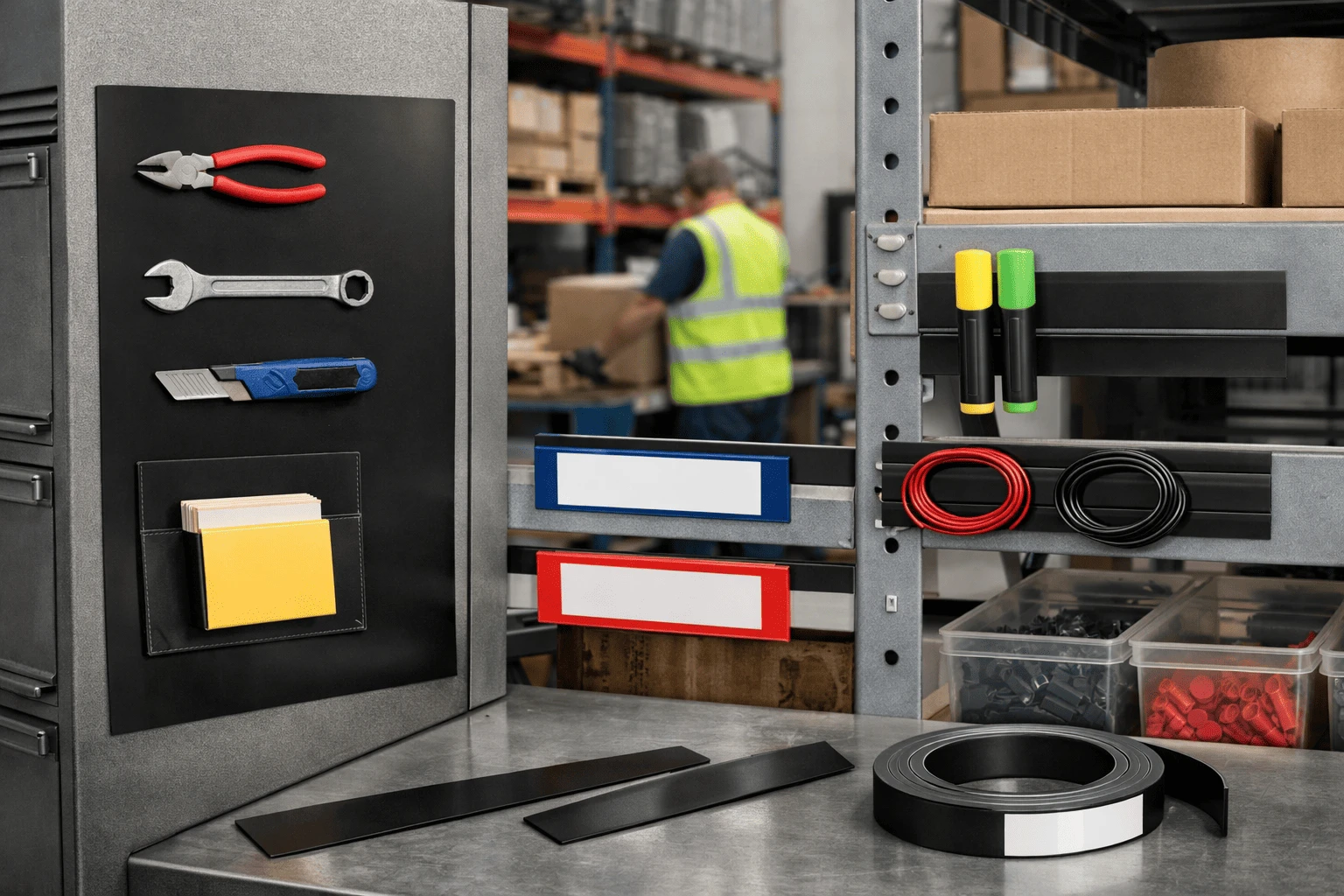
Risk reduction begins with choosing magnets suited to controlled, visible use. Small, clearly visible magnets are appropriate for light-duty holding where visibility and ease of handling are important. Their size and finish make them easier to identify and manage safely in shared environments. For applications involving repeated attachment and removal, reclosable magnetic pads allow a more controlled connection. By reducing sudden snapping and allowing predictable separation, they help limit strain and handling risks. Selecting magnets that balance holding power with usability supports safer day-to-day operations.
Clear organisation is a fundamental component of workplace safety. Visual management systems help workers quickly understand where items belong, which areas are designated for specific tasks, and what information is current. Magnets & Magnetic Materials are particularly effective in these systems, as they allow layouts and labels to be updated or repositioned without permanent alteration.
Using magnetic solutions such as label holders and dry-wipe tapes supports consistent identification of shelving, storage zones, and equipment locations. This flexibility reduces confusion, prevents misplacement, and lowers the likelihood of trip hazards or workflow interruptions. In environments where processes or stock change frequently, the ability to adjust labels easily helps maintain accuracy and clarity. By incorporating Magnets & Magnetic Materials thoughtfully, industrial workplaces can standardise practices across teams and shifts, reduce misunderstandings, and foster safer, more organised routines.
Human error often arises when systems are rigid, unclear, or difficult to maintain. Magnetic organisation tools introduce flexibility while preserving structure. Because they are removable and adjustable, they encourage correct use rather than workarounds.
Reliability is a key safety consideration. Industrial magnets are often exposed to dust, moisture, vibration, and frequent handling. Over time, low-quality materials or weak adhesives can degrade, increasing the risk of detachment. Magnetic sheets with strong adhesive backing are designed to maintain secure attachment in demanding conditions, helping signage or protective materials remain in place. Similarly, steel-backed magnetic surfaces can be used to improve load distribution, reducing stress on individual magnets.
While magnets themselves are not regulated as standalone safety equipment, their use falls within broader workplace safety responsibilities. Employers are expected to assess risks and ensure that tools are suitable for their intended purpose. Using durable, predictable magnetic solutions supports these assessments by reducing uncertainty around performance. Consistency in behaviour makes inspection, maintenance, and training simpler, helping businesses integrate magnets into safe systems of work without unnecessary complexity.
Industrial magnets are small components with significant influence over workplace safety. When selected with an understanding of real-world strength, handling risks, and environmental demands, they can support safer, more organised industrial environments.
The key is balance. Appropriate strength, clear visibility, reliable materials, and suitability for the task all contribute to safer outcomes. Magnets should support workflows, not complicate them, and reliability over time is just as important as initial performance. By taking a considered approach to magnet selection and use, UK workplaces can reduce avoidable risks, improve organisation, and create environments where safety is supported through practical, well-chosen tools. For more detailed information on industrial magnetic solutions and materials, UK businesses can refer to industrialmaterial.uk.

I am Oliver, a blog writer who enjoys creating clear, engaging, and meaningful content for readers. I like exploring different topics and turning ideas into simple, easy-to-understand articles that provide real value. My focus is on writing in a natural and creative way so readers can stay interested and connected. Through my blogs, I aim to inform, inspire, and share useful insights with my audience.
Staircases are one of the most frequently used and most frequently overlooked parts of any building.
3 September 2026
Walk through almost any busy commercial building — a warehouse, an office, a retail store, a s
1 September 2026
When people think about safety in bags, outdoor gear, and apparel, they usually focus on visible ele
18 February 2026
Be the first to share your thoughts
No comments yet. Be the first to comment!
Share your thoughts and join the discussion below.


.webp&w=3840&q=75)
.webp&w=3840&q=75)


.webp&w=3840&q=75)