
Thursday, May 21, 2026
* All product/brand names, logos, and trademarks are property of their respective owners.
Every aquatic facility depends on trained professionals who can recognize danger, prevent accidents, and respond immediately during emergencies. Whether at a swimming pool, beach, lake, or waterpark, lifeguards play a critical role in protecting public safety. But before anyone becomes a professional lifeguard, they must complete a proper lifeguard course.
Today, many people search online for:
A professional lifeguard course teaches much more than swimming skills. It prepares students to handle high-pressure situations using rescue techniques, CPR, AED training, first aid knowledge, surveillance skills, and teamwork. These programs help individuals become confident responders capable of protecting lives in aquatic environments.
This article explains how a lifeguard course works, what students learn during training, and why certification is essential for building a successful career in aquatic safety.
Many people believe strong swimmers can automatically become lifeguards, but swimming ability alone is not enough during emergencies.
Professional training teaches lifeguards how to:
Without proper instruction, even experienced swimmers may panic or use unsafe rescue methods during real emergencies.
Organizations such as the American Red Cross, American Lifeguard Association, and United States Lifesaving Association establish professional training standards to ensure lifeguards are properly prepared.
Lifeguard courses combine classroom learning, practical rescue training, emergency response practice, and physical conditioning.
Students learn important topics related to aquatic safety, including:
Understanding these concepts helps lifeguards make better decisions during emergencies.
Hands-on rescue practice is one of the most important parts of the course.
Students participate in:
Realistic training prepares students for real-world situations.
Water rescue training is the foundation of every professional lifeguard course.
Lifeguards are trained to assist swimmers safely without entering the water whenever possible.
Common rescue tools include:
These methods reduce risk while helping distressed swimmers quickly.
Throwing assists involve tossing flotation equipment to victims from a safe distance.
Students practice:
Active victims are conscious swimmers struggling in the water.
Students learn:
Training emphasizes maintaining safety during stressful situations.
Passive victims may be unconscious or unable to assist themselves.
Training includes:
These drills prepare students for critical rescue situations.
Spinal injuries require specialized handling to avoid further harm.
Lifeguards practice:
Hands-on repetition improves confidence and technique.
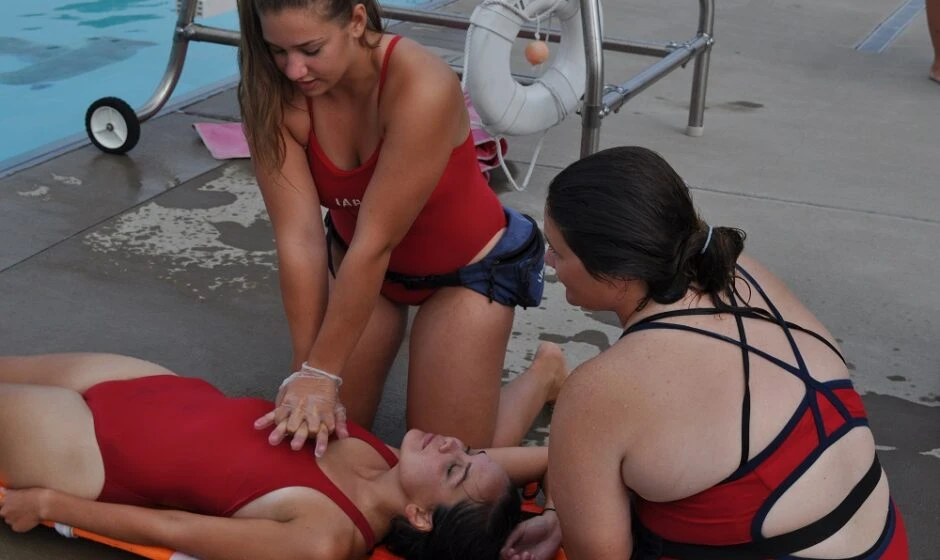
Lifeguards are often the first responders during medical emergencies.
Students learn CPR procedures for:
Training includes:
Repeated practice helps students perform CPR effectively under pressure.
AED stands for Automated External Defibrillator.
Students learn:
Fast CPR and AED use can significantly improve survival rates during cardiac emergencies.
Lifeguard courses also teach treatment for:
These medical skills are valuable both inside and outside aquatic environments.
The best lifeguards prevent emergencies before rescues become necessary.
Lifeguards are trained to constantly monitor swimmers and aquatic environments.
Students learn how to:
Strong surveillance skills help reduce accidents and improve emergency response times.
Lifeguards are trained to identify hazards such as:
Recognizing hazards early helps create safer environments.
Many students underestimate the physical intensity of lifeguard training.
Most programs require students to:
These tests ensure lifeguards are physically capable of handling emergencies.
Real rescues may involve:
Physical endurance helps lifeguards respond safely and effectively.
Lifeguarding requires concentration, discipline, and emotional control.
During emergencies, lifeguards must:
Scenario-based training helps students improve confidence and critical thinking.
Most rescues involve multiple lifeguards working together.
Students practice:
Strong teamwork improves rescue efficiency and safety.
Different aquatic environments require specialized training.
Pool lifeguards commonly work at:
Training focuses on controlled aquatic environments.
Waterfront lifeguards supervise:
Additional training addresses:
Surf lifeguards work in ocean environments with constantly changing conditions.
Training may include:
Surf lifeguarding is one of the most physically demanding lifeguard specialties.
Professional training offers both career and personal advantages.
Certified lifeguards are needed at:
Searches for “lifeguard jobs near me” and “summer lifeguard positions” continue to grow every year.
Lifeguard courses help students develop:
These transferable skills are useful in many future careers.
Lifeguards help create safer aquatic environments and protect lives within their communities.
Few jobs provide such direct opportunities to help others.
Not every training provider offers the same quality of instruction.
When selecting a program, look for:
Programs associated with organizations like the American Red Cross and American Lifeguard Association are widely respected by employers.
A professional lifeguard course prepares individuals to prevent emergencies, perform rescues, and respond confidently during high-pressure situations. Through water rescue practice, CPR certification, first aid education, and surveillance training, students gain the skills needed to protect lives in aquatic environments.
Whether you are searching for “lifeguard course near me,” “how to become a lifeguard,” or the “best lifeguard certification program,” professional training is the first step toward a respected and rewarding career in aquatic safety.
Lifeguarding is more than a job — it is a commitment to responsibility, leadership, teamwork, and life-saving service.

No bio available yet.
Be the first to share your thoughts
No comments yet. Be the first to comment!
Share your thoughts and join the discussion below.
.webp&w=3840&q=75)