Saturday, October 17, 2026
* All product/brand names, logos, and trademarks are property of their respective owners.
Walk through almost any busy commercial building — a warehouse, an office, a retail store, a school corridor — and you'll spot the same telltale scars: scuffed corners, chipped paint, and dented drywall where a cart, trolley, or piece of equipment met an unforgiving 90-degree edge. It's a small problem, but it's a persistent one, and it's exactly why a simple corner wall protector has quietly become one of the most practical facility upgrades that gets overlooked until the damage bill arrives.
Corners take more abuse than almost any other part of a wall, especially in spaces built for constant movement. They're where trolleys clip the plaster, where forklifts and pallet jacks brush past in tight turns, and where drywall's outer corner bead — often just a thin strip of metal or paper tape under the plaster — is most vulnerable to cracking. A wall corner protector solves this cheaply and quickly, without requiring a repaint or a call to a contractor every few months.
This guide breaks down what these products actually do, the different types available, how to choose the right one for a commercial setting, and how to install it so it actually stays put under daily wear.
Corners are structurally the weakest point of interior walls for a simple reason: they concentrate impact. A flat wall surface can absorb a glancing knock, but a 90-degree edge takes the full force of any collision directly on a narrow strip of drywall, paint, or joint compound. In commercial spaces, that impact is far more frequent than in a typical home.
A few common culprits show up again and again:
None of this is dramatic on its own, but it adds up fast in a commercial environment. Repeated minor impacts — dozens of them a day, day after day — are usually what actually cracks corner bead or chips paint, not one big collision.
A wall corner protector (sometimes called a corner wall guard or wall edge protector) is a strip or moulded piece of material that fits over an exposed wall corner to cushion impact and protect the surface underneath. Most are made from foam, rubber, PVC, or a rigid decorative material like wood-look composite or moulded polymer.
They generally serve one of two purposes in a commercial setting, and often both:
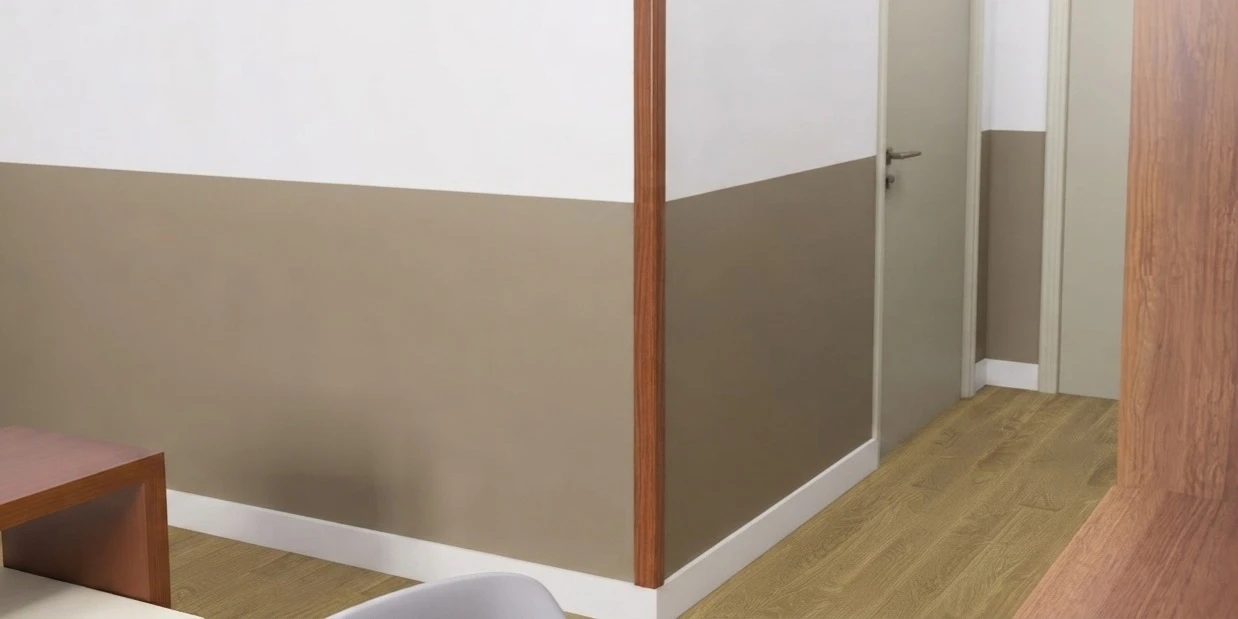
It brings a finished, architectural look to corners that still need protection — a common choice in offices, hotels, showrooms, and reception areas where bare plastic or foam guards would look out of place. Made from moulded composite or laminate-wrapped MDF, it's designed to mimic real timber trim or skirting, so it reads as a deliberate design feature rather than an add-on.
They offer a good middle ground — more durable than foam, still cushioned, and often designed with a low profile that doesn't disrupt a professional look. These work well in corridors with moderate foot and cart traffic.
These corner protectors are built for the highest-traffic commercial areas — warehouses, loading bays, stockrooms, and busy corridors. They resist scuffing, wipe clean easily, and hold up to repeated contact from trolleys and equipment, though they offer less shock absorption than foam or rubber.
They cover other finish-first options beyond wood effect — clear or tinted mouldings, painted trims, and profiles designed to blend into a specific colour scheme. Like wood effect trim, these suit reception areas, showrooms, or client-facing spaces where appearance matters as much as protection.
Not every corner in a commercial building needs the same solution. A few questions can narrow down the right choice quickly.
A quiet office corridor has very different needs than a loading bay or a shared stockroom entrance. High-traffic areas benefit from rigid or rubber options that hold up to repeated contact from equipment and trolleys.
Textured walls, painted surfaces, or freshly finished fit-outs need adhesive-friendly guards that won't damage the finish on removal. Always check whether a product uses permanent adhesive, a removable mounting strip, or screws, and match it to the wall type and any lease conditions.
In a stockroom or plant room, function usually wins. In a reception area, showroom, or client-facing corridor, a low-profile or decorative guard makes more sense than a bulky protective bumper.
For anyone comparing specific product options and finishes, resources like https://www.doorthresholds.co.uk/ offer a useful look at the range of styles available, from discreet clear guards to more visible decorative trims — helpful for narrowing down what fits a particular commercial space.
A poorly installed corner protector is almost as frustrating as no protector at all — it peels, shifts, or fails right when a busy corridor needs it most. A few basics make a real difference:
Wall corners in a commercial building rarely get much thought until they're chipped, cracked, or a client notices the scuffed paint on the way to a meeting room. A wall corner protector is one of those rare facility fixes that's cheap, fast to install, and genuinely solves the problem it's designed for — whether that's preserving a fresh fit-out, protecting a lease deposit, or reducing the injury risk in a busy corridor.
The key is matching the product to the setting:
rigid and durable for warehouses and loading areas, cushioned for spaces with heavy foot traffic, and decorative where appearance matters most. Get that match right, and it's a quick job that saves a much bigger repair bill down the line.

Staircases are one of the most frequently used and most frequently overlooked parts of any building.
3 September 2026
When people think about safety in bags, outdoor gear, and apparel, they usually focus on visible ele
18 February 2026
In industrial and commercial environments, magnets are often treated as simple, low-risk components.
5 February 2026
Be the first to share your thoughts
No comments yet. Be the first to comment!
Share your thoughts and join the discussion below.