Thursday, October 15, 2026
* All product/brand names, logos, and trademarks are property of their respective owners.
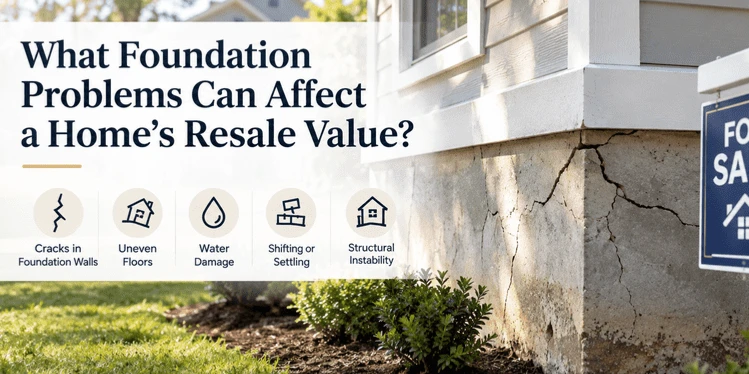
A buyer can forgive dated countertops. They can repaint a bedroom, swap a light fixture, or rip out carpet. What they rarely forgive is a house that might be moving.
That is the reason foundation trouble carries so much weight in a sale. It is not a cosmetic flaw. It raises questions about the structure itself, and once a buyer starts asking questions, price negotiations tend to follow.
So what foundation problems can affect a home's resale value, and how much should a seller worry? The answer depends on the type of problem, its cause, and whether it is documented and addressed. This guide walks through each of those points so you know what to expect before a buyer's foundation inspection company arrives.
A foundation carries the entire weight of the house. When it shifts, cracks, or lets in water, the effects can spread to walls, floors, doors, windows, plumbing, and the roofline.
Buyers also know foundation repairs can be disruptive and expensive. Most are not builders, so they cannot tell a harmless settling crack from a serious structural one. When they cannot judge the risk, they tend to assume the worst and price it in.
That uncertainty often costs sellers more than the problem itself. A minor, well-understood issue with a clear explanation can be far less damaging than a vague one nobody has looked at.
Every house settles a little. The trouble starts when one part sinks more than another, a pattern called differential settlement. It often shows up as sloping floors, gaps between walls and ceilings, or doors that stick or swing open on their own.
Buyers can sense it without being told. A marble that rolls across the kitchen floor is hard to explain away.
Not every crack is a red flag. Thin, hairline cracks in concrete are common as it cures and ages. The ones that worry New home inspectors tend to be wider, grow over time, run diagonally, or show one side sitting higher than the other.
Stair-step cracks in brick or block, and horizontal cracks in basement walls, deserve a professional look. Horizontal cracking, in particular, can point to soil pressure pushing against the wall.
A basement or foundation wall that curves inward is among the more serious findings. It suggests the wall is under a load it was not built to handle, often from saturated soil outside.
This is the kind of issue that tends to push buyers toward a hard renegotiation or a walk-away, because the repair is rarely minor.
Moisture is a quiet driver of foundation damage and a common reason for a poor inspection report. Standing water near the house, gutters that dump beside the wall, or soil that slopes toward the foundation can all contribute.
Inside, the signs include damp basements, musty smells, white mineral deposits on concrete, peeling paint, and mold. Even when the foundation itself is sound, a wet basement can reduce a home's appeal and usable space.
Some soils expand when wet and shrink when dry. Over time, that cycle can lift or drop parts of a foundation. Tree roots can add to the problem by pulling moisture from the ground near the house.
Because soil conditions vary widely by region, what counts as a common issue in one area may be rare in another.
Damage to wood framing and crawl spaces
In homes with crawl spaces, damp conditions can lead to rot, pest activity, and sagging floors. A buyer who sees damaged support beams or sill plates will often assume the damage reaches further than what is visible.
Plumbing leaks under or near the slab
A leak beneath a slab can erode the soil that supports it. Buyers may not see the cause directly, but a history of unexplained moisture or high water bills may come up during inspection and raise concerns.
Foundation concerns rarely show up as a single line item. They tend to ripple through the transaction.
None of these outcomes is guaranteed. Each depends on severity, local market conditions, and how transparent the seller is.
There is no single right answer, but there is a smart way to decide.
Start by finding out what you are actually dealing with. A structural engineer can assess whether a crack is cosmetic or serious, and their written report becomes a useful document either way.
From there, the decision usually comes down to a few questions:
A repaired foundation with paperwork is often easier to sell than an unrepaired one with questions attached. That said, repairs don't always return their full cost in sale price, so it is worth discussing the numbers with a local real estate agent before committing.
Rules about what sellers must disclose vary by state and sometimes by city. In many places, known material defects, including foundation problems, have to be disclosed.
Hiding a known issue can create legal exposure after closing, and it rarely works anyway, since inspectors are trained to look for the signs. If you are unsure of your obligations, a real estate attorney or licensed agent in your area can tell you what applies. This article is general information, not legal advice.
A quick walk around your own home can save surprises later. Look for:
If you notice more than one of these, treat it as a reason to get a professional Los Angeles home inspection opinion rather than a reason to panic.
Foundation problems affect resale value in two ways: through the physical issue itself and through the doubt it creates in a buyer's mind. Sellers cannot control every outcome, but they can control how much mystery surrounds their home.
Know what you have, get it evaluated, fix what makes sense to fix, and keep the records. Buyers pay more for a house they trust than for one they have to guess about.

No bio available yet.
Owning a rental property can be stressful. Tenants call at 2 AM about a broken boiler. Rent arrives
11 June 2026
Be the first to share your thoughts
No comments yet. Be the first to comment!
Share your thoughts and join the discussion below.