Sunday, October 18, 2026
* All product/brand names, logos, and trademarks are property of their respective owners.
Staircases are one of the most frequently used and most frequently overlooked parts of any building. They see constant footfall, carry the weight of daily wear, and are often the first place where flooring starts to fail. When that happens, the edge of the step usually goes first, and a worn or slippery stair edge is one of the leading causes of trips and falls in both commercial and residential properties.
That's where anti-slip stair nosing comes in. It's a small addition to a staircase, but its impact on safety, compliance, and long-term maintenance costs is significant. For property owners, facility managers, and contractors alike, understanding how it works and which type suits a given project can prevent accidents before they happen and save money on repairs down the line.
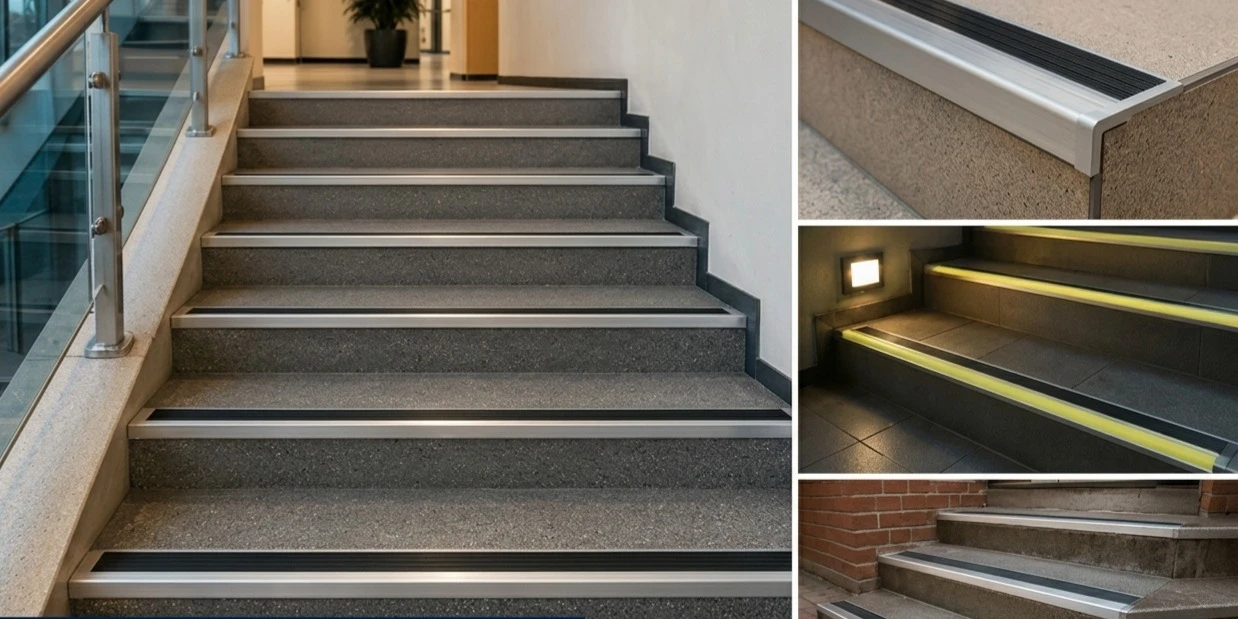
Stair nosing is the strip fitted to the leading edge of a step, the part that sticks out slightly and takes the brunt of foot traffic. Anti slip stair nosing is specifically designed with a textured or gritted surface that improves grip, making it far less likely that someone will slip, particularly on stairs made from smooth materials like tile, vinyl, or polished concrete.
Beyond grip, nosing also protects the step edge itself. Corners and edges are the first areas to chip, crack, or wear thin, so a well-fitted nosing profile extends the life of the entire staircase while clearly marking where one step ends and the next begins, which is especially useful for anyone with limited vision.
Falls on stairs are not a minor issue. In the UK, slips, trips, and falls account for a substantial share of workplace injuries reported to the Health and Safety Executive each year, and staircases are consistently among the locations where these incidents occur most often. Many of these accidents happen not because a staircase is fundamentally unsafe, but because the step edges have become worn, discoloured, or difficult to distinguish from one another.
The good news is that this is one of the more straightforward risks to manage. Unlike a full staircase refurbishment, fitting nosing is quick, relatively inexpensive, and doesn't require taking a staircase out of use for long. It's a practical fix with a genuinely high return in terms of reduced liability and improved confidence for anyone using the stairs, from staff and residents to visiting members of the public.
Not every staircase has the same requirements, and material choice matters more than many people expect. The right option depends on the existing flooring, the level of foot traffic, and whether the installation needs to be permanent or easily replaceable.
Aluminium stair nosing is the go-to choice for high-traffic commercial environments such as offices, schools, and retail units. It's durable, resistant to corrosion, and holds up well under heavy or constant use. Aluminium profiles are often fitted with a coloured insert strip, which not only adds grip but also improves visibility, helping to meet accessibility standards for step edge contrast.
UPVC stair nosing is a cost-effective and versatile option, particularly well suited to residential settings or areas with moderate footfall. It's lightweight, straightforward to cut and fit, and available in a range of colours that can be matched to existing stair finishes. For landlords or property managers working across multiple units, UPVC offers a practical balance between cost and performance.
For projects where minimal disruption matters, self-adhesive stair nosing is often the most practical solution. It requires no drilling or specialist tools, which makes it ideal for rented properties, temporary installations, or situations where a fast turnaround is essential. While it may not be the first choice for extremely high-traffic areas, it performs well in offices, care homes, and residential stairwells where a reliable, tidy finish is needed without a lengthy fitting process.
Luxury vinyl tile flooring has become a popular choice in both commercial and residential refurbishments, and LVT stair nosing is designed specifically to complement it. These profiles are built to match the thickness and finish of LVT flooring, creating a seamless transition at the step edge rather than an obvious add-on. This matters both aesthetically and functionally, since a mismatched nosing profile can create an uneven edge that becomes a trip hazard in its own right.
Bullnose stair nosing has a smooth, rounded profile that suits staircases where a softer, more traditional appearance is preferred. It's a common choice in hotels, care facilities, and residential buildings where safety needs to be balanced with visual comfort. The rounded edge also reduces the risk of catching a foot on a sharp lip, which can be a particular concern for elderly residents or anyone using the stairs with mobility aids.
Fitting nosing correctly matters as much as choosing the right product. Rushed installation is one of the most common reasons nosing fails prematurely, either lifting at the edges or failing to bond properly with vinyl or tiled surfaces.
Installation checklist:
| Step | What to check |
|---|---|
| Measuring | Take exact width measurements for each step; profiles are rarely uniform across an entire staircase |
| Surface prep | Clean and dry the step edge fully before fitting; dust or residue weakens adhesive bonds |
| Fixing method | Match the fixing (adhesive, screw-fix, or mechanical) to both the nosing material and the existing floor surface |
| Alignment | Fit each profile flush with the step edge to avoid creating a new trip hazard |
| Curing time | Allow adhesive-fitted profiles proper curing time before reopening the staircase to heavy traffic |
Compliance is just as important as fitting technique, particularly on commercial and public sector projects:
Contractors working on commercial fit-outs or public sector projects should check these specifications early in the planning process rather than treating nosing as an afterthought.
Once fitted, stair nosing generally requires very little upkeep. Regular cleaning to remove grit and debris from the textured grip strip helps maintain its effectiveness, and periodic checks for lifting edges or loosening fixings can catch problems before they become safety issues. Aluminium and UPVC profiles tend to last many years with minimal maintenance, while adhesive-fitted options should be inspected a little more frequently, particularly in areas with heavy footfall or exposure to moisture.
Most profiles are designed with specific flooring types in mind. LVT nosing suits vinyl tile floors, while aluminium and UPVC options work across tile, wood, concrete, and carpeted stairs. Checking the flooring thickness before ordering helps ensure a flush, even fit.
Aluminium nosing can last well over a decade with normal use, UPVC profiles typically perform well for several years, and self-adhesive options tend to need replacing sooner, especially in high-traffic areas, though this varies with footfall and maintenance.
In many public and commercial buildings, yes. Part M of the Building Regulations requires visible contrast on step edges, so factor this into material selection rather than treating it as optional.
Yes. In most cases, old or damaged nosing can be removed and replaced without disturbing the surrounding flooring, making it a practical fix rather than a full renovation project. For product specifications and sizing guides.
Stair nosing rarely gets much attention until something goes wrong, but it's one of the more cost-effective safety measures available for any staircase. Whether the priority is durability, quick installation, or matching a specific flooring type, there's a suitable option available, and getting this detail right pays off in fewer accidents, lower liability, and staircases that simply last longer.
For anyone managing a building, planning a renovation, or specifying materials for a new build, choosing the right stair nosing early is a decision worth making, rather than revisiting it after an avoidable accident. Full product ranges and specifications are available at https://www.stairsnosing.co.uk/.

Walk through almost any busy commercial building — a warehouse, an office, a retail store, a s
1 September 2026
When people think about safety in bags, outdoor gear, and apparel, they usually focus on visible ele
18 February 2026
In industrial and commercial environments, magnets are often treated as simple, low-risk components.
5 February 2026
Be the first to share your thoughts
No comments yet. Be the first to comment!
Share your thoughts and join the discussion below.