Thursday, October 15, 2026
* All product/brand names, logos, and trademarks are property of their respective owners.
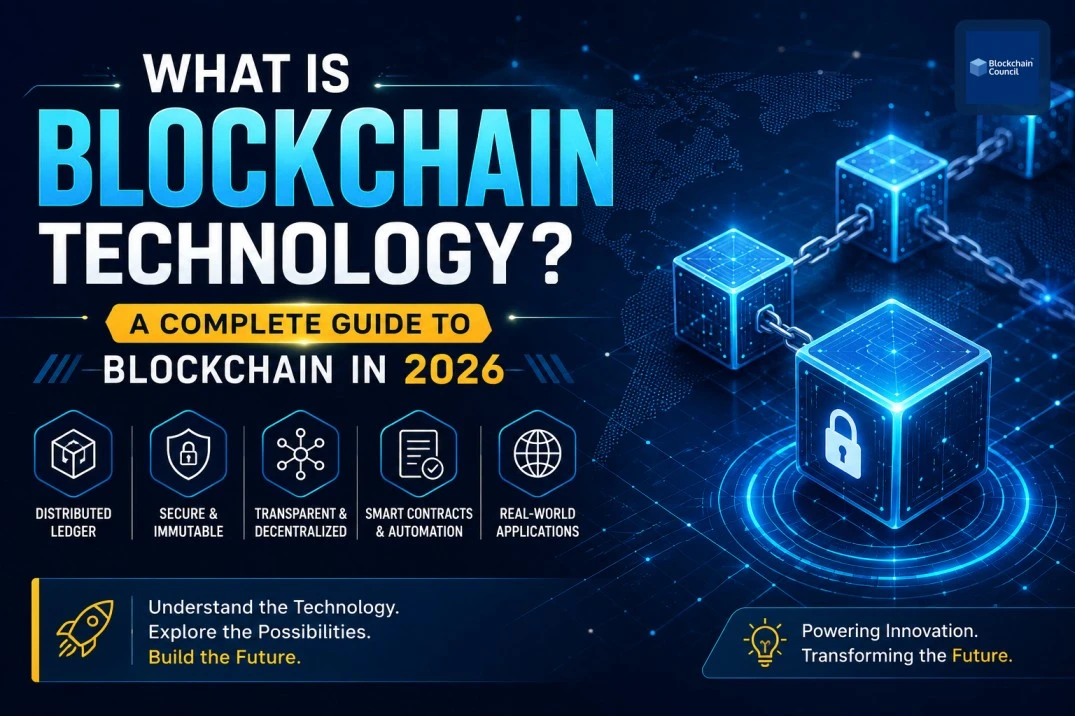
Blockchain is one of the most important technologies in the digital world. It provides a new way to record, verify, and share information without depending entirely on a central authority. From cryptocurrency and financial services to supply chains and digital identity, blockchain is being explored across many industries.
In simple terms, blockchain is a decentralized digital ledger that stores information across a network of computers. Instead of keeping records in one central database, blockchain distributes them among multiple participants. This structure can improve transparency, security, and trust. As blockchain adoption grows, learning its fundamentals can help professionals build the knowledge needed to become a Blockchain Expert.
Blockchain is a digital record-keeping technology that stores information in groups called blocks. Each block contains transactions or other data. After a block is verified, it is connected to the previous block, creating a chronological chain.
Blockchain uses cryptographic techniques to protect stored information. In decentralized networks, records are maintained across multiple computers rather than being controlled by a single organization.
This makes blockchain different from traditional databases. A traditional database is usually managed by a central authority, while a decentralized blockchain allows multiple participants to maintain and verify records.
The process starts when a user initiates a transaction. The transaction is shared with the blockchain network, where participating computers, known as nodes, verify it according to the network's rules.
After verification, the transaction can be grouped with other approved transactions into a block. A consensus mechanism allows network participants to agree on whether the block should be added to the chain.
Once added, the block becomes part of the blockchain record. Each block contains cryptographic information that connects it to the previous block. This makes unauthorized changes difficult because modifying an earlier record can affect the blocks that follow it.
Blockchain networks can operate without depending entirely on a single central authority. Data can be distributed across multiple computers.
Many blockchain networks allow participants to view transaction records. This can make activities easier to track and verify.
Blockchain uses cryptography to protect information and verify transactions before they are added to the network.
Changing information after it has been added to a blockchain can be difficult, particularly on well-established decentralized networks.
Blockchain can maintain a chronological record of transactions, making it useful for tracking products, payments, and other activities.
Blockchain became widely known through cryptocurrency. Bitcoin demonstrated how blockchain could record digital transactions without relying on a traditional intermediary to maintain the transaction ledger.
However, blockchain is much broader than cryptocurrency. Organizations are exploring it for finance, healthcare, supply chain management, real estate, digital identity, entertainment, and other industries.
Blockchain can support financial organizations by improving transaction records and settlement processes. It may also reduce administrative work in certain applications.
Companies can use blockchain to record the movement of products through different stages of a supply chain. This can improve visibility and help verify product information.
Blockchain can be explored for managing and sharing healthcare records. With suitable privacy controls, authorized users can access reliable information while maintaining data integrity.
Smart contracts are programs that run on blockchain networks. They can automatically perform predefined actions when specific conditions are met, helping automate certain agreements and processes.
Blockchain-based systems can provide new ways to manage digital credentials. Depending on the system, users may gain greater control over how certain information is verified and shared.
Blockchain knowledge can benefit students, developers, entrepreneurs, business professionals, and technology enthusiasts. Learning the technology helps individuals understand concepts such as distributed ledgers, cryptography, consensus mechanisms, smart contracts, and decentralized applications.
Professionals who want to strengthen their technical skills can also explore Tech Certifications as part of their career development. Blockchain knowledge can complement other technology skills and help professionals understand emerging digital solutions.
Blockchain is also relevant to non-technical professionals. Business owners, marketers, managers, and consultants can learn how blockchain may influence business models, digital assets, customer experiences, and industry processes. Marketing and Business Certifications can also help professionals develop broader skills in business, marketing, and strategy.
Blockchain offers several benefits, but it also has limitations. Scalability remains a challenge for some networks because higher transaction volumes can affect processing speed and costs.
Energy consumption can also be a concern for networks that use energy-intensive consensus mechanisms. Newer approaches are being developed to improve efficiency.
Regulation is another important consideration. Governments and regulatory organizations continue to develop rules for cryptocurrencies, digital assets, smart contracts, and blockchain applications.
Blockchain can also be technically complex, so organizations need professionals who understand both its technical and business applications.
Blockchain technology continues to evolve. Its future applications may include finance, supply chains, digital identity, decentralized applications, and digital assets.
Blockchain may also work alongside artificial intelligence, Internet of Things (IoT), cloud computing, and cybersecurity. These technologies could create new ways to manage information, automate processes, and deliver digital services.
As adoption grows, professionals with blockchain knowledge may find opportunities across technology, finance, consulting, cybersecurity, and supply chain management.
Blockchain provides a new approach to recording, verifying, and sharing digital information. Its decentralized structure, security, transparency, and traceability make it useful for many applications beyond cryptocurrency.
From financial services and supply chains to smart contracts and digital identity, blockchain has the potential to influence how organizations manage information and digital transactions.
For students and professionals, learning blockchain can be a valuable step toward understanding an important emerging technology. Whether someone wants to build technical expertise or explore business applications, blockchain knowledge can provide a strong foundation for the digital future.
Blockchain is a decentralized digital ledger that records and stores information across a network of computers. It allows transactions to be verified without relying entirely on a central authority.
Blockchain stores information in connected blocks. Network participants verify transactions before they are added to the chain, while cryptographic methods help protect the records.
No. Blockchain can also be used in finance, healthcare, supply chains, digital identity, real estate, smart contracts, and other industries.
A Blockchain Expert is a professional with strong knowledge of blockchain concepts such as distributed ledgers, cryptography, consensus mechanisms, smart contracts, and blockchain applications.
Blockchain uses cryptography, distributed networks, and consensus mechanisms to protect information. However, security also depends on the network, applications, smart contracts, and user practices.
Useful skills include blockchain architecture, cryptography, smart contracts, programming, cybersecurity, decentralized applications, and distributed systems.
Beginners can start with blockchain fundamentals such as blocks, transactions, decentralization, cryptography, consensus mechanisms, and smart contracts. Practical projects and professional certifications can help develop deeper knowledge.

No bio available yet.
Every seasoned Business Analyst shares a common professional trauma: the stakeholder who looks you d
3 July 2026
Football is widely recognized as the most popular sport in the world. It is played and watched by bi
16 June 2026
If you spend enough time reading tech forums or listening to project management evangelists, you&rsq
8 June 2026
Be the first to share your thoughts
No comments yet. Be the first to comment!
Share your thoughts and join the discussion below.