Monday, September 21, 2026
* All product/brand names, logos, and trademarks are property of their respective owners.
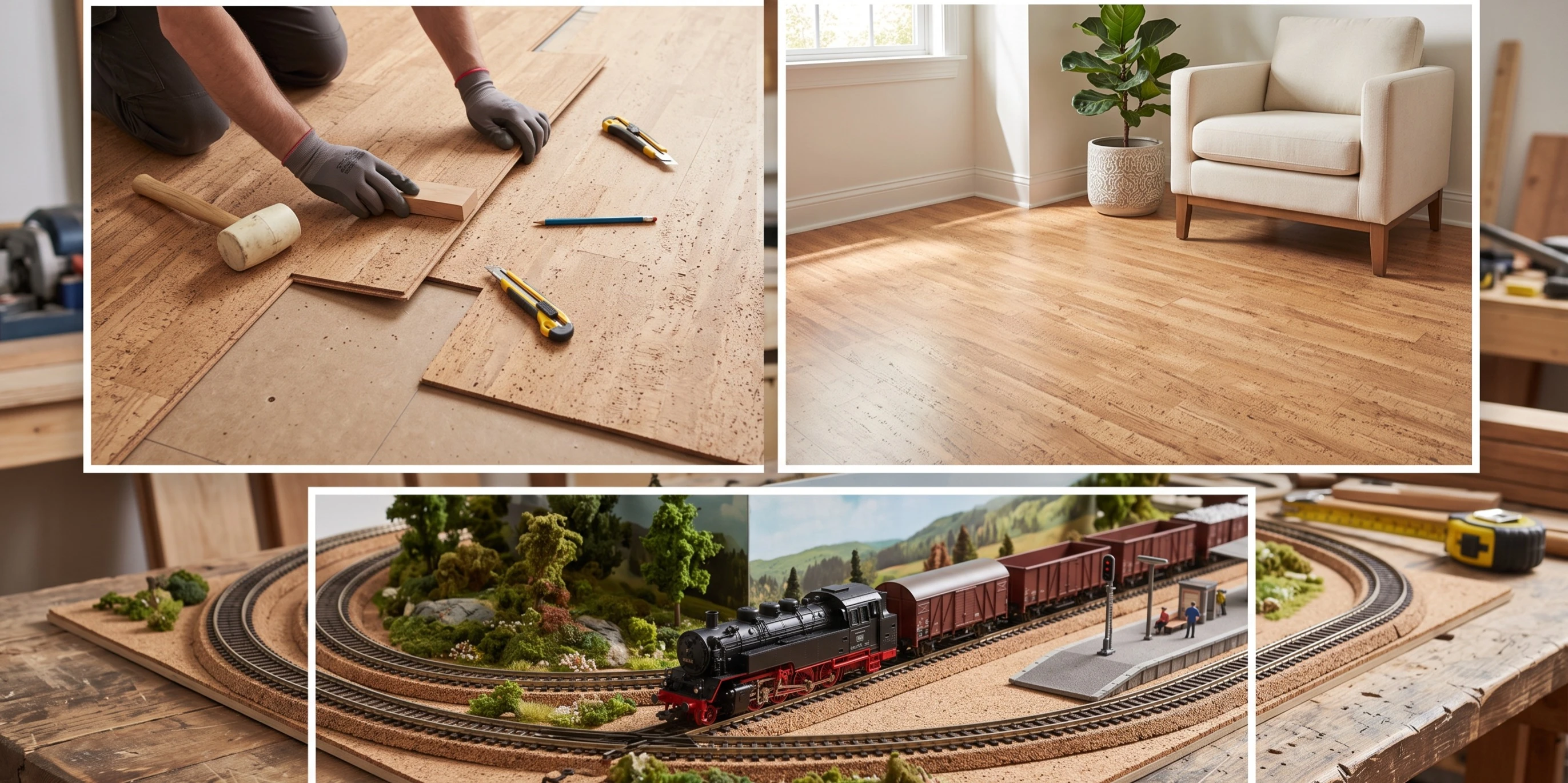
Cork has been used in homes and workshops for generations, yet it's often overlooked in favour of more familiar flooring and building materials. In truth, cork is one of the most adaptable natural materials available, valued for its comfort underfoot, its insulating properties, and its usefulness well beyond the floor. From cork flooring supplies for a kitchen renovation to cork bark for a model railway layout, this versatile material turns up in some surprising places.
This guide looks at why cork works so well across different projects, how cork flooring and its accessories fit together, and how specialist products such as cork expansion joints and model railway cork bark serve very different yet equally practical purposes.
Cork comes from the bark of the cork oak tree, harvested without felling the tree, which is part of why it's often grouped among sustainable flooring materials. But its popularity isn't just about where it comes from — it's about what it does.
A few properties make cork stand out:
These qualities explain why cork shows up not only underfoot but in soundproofing, packaging, craft projects, and even hobby modelling, which we'll come to later.
Cork flooring itself is only part of the picture. A successful installation usually depends on the accessories that support it. Cork underlay, for instance, is commonly laid beneath other flooring types — laminate, engineered wood, or tiles — to reduce noise transmission and add a layer of cushioning.
Cork rolls and cork sheets serve a broader range of purposes. Depending on thickness and finish, they can be used as flooring underlay, noticeboard material, craft backing, or even acoustic panelling. Because cork is easy to cut to size, many DIY enthusiasts keep a roll or sheet on hand for smaller jobs that call for a bit of natural flooring material rather than a full flooring supply order.
When people search for cork flooring accessories, they're often looking for these supporting products rather than the floor covering itself — items that make an installation neater, quieter, or longer-lasting. If you want to see the range of formats available, it's worth taking a look at what's currently offered; you can explore the full range to get a sense of the different roll sizes and thicknesses on the market.
One accessory that's easy to overlook until it's needed is the expansion joint. Most flooring and building materials expand and contract slightly with changes in temperature and humidity. Without somewhere for that movement to go, floors can buckle, tiles can crack, and joints between materials can come under strain.
A cork expansion joint is designed to sit in the gap between flooring sections, or between flooring and a fixed structure such as a wall or column, allowing that natural movement to happen without causing damage. Because cork is compressible, it can absorb small shifts in the surrounding materials rather than transferring stress onto rigid edges.
Cork expansion strips and joints are typically used in:
Flooring expansion joints don't need to be conspicuous. In many cases, a cork strip disappears neatly along a skirting line or threshold, doing its job quietly rather than standing out. For anyone specifying or installing flooring at scale, factoring in expansion provision at the planning stage tends to save problems later on.
Away from flooring altogether, cork bark has become a favourite among model railway hobbyists and diorama builders. Its rough, irregular texture makes it well suited to representing rock faces, cliffs, and weathered terrain at miniature scale — details that would be difficult to achieve convincingly with smoother materials.
Model railway cork bark is commonly used for:
Because cork bark is lightweight and easy to break or cut into smaller pieces, it's a forgiving material for hobbyists at any skill level. It can be painted, weathered, and blended with scatter materials or static grass to build up a convincing scene layer by layer. For model railway scenery in particular, cork bark offers a good balance between realism and ease of use — something that's harder to achieve with resin or plaster alternatives, which often require more specialist handling.
Beyond flooring and modelling, cork turns up in a surprising number of everyday and DIY contexts. Cork sheets are popular for pinboards and noticeboards. Cork rolls can be repurposed as drawer liners, protective padding, or craft bases. In workshops, cork is sometimes used as a cushioning layer under tools or equipment, thanks to its shock-absorbing qualities.
For anyone tackling cork for DIY projects more generally, the material's combination of flexibility and durability makes it a practical choice where a softer, natural surface is needed but heavier materials would be impractical.
If you're comparing cork products for a specific project, checking product dimensions and thicknesses against your intended use is a sensible starting point — full details are listed at
https://www.corkrolls.co.uk/, which can help narrow down which format suits the job.
With such a wide range of cork products available, from cork underlay to cork bark, it helps to think through a few practical questions before buying:
Taking a few minutes to match the product to the project avoids the common mistake of buying a format that's technically "cork" but not well suited to the task at hand.
Cork's reputation as a flooring material only tells part of its story. Whether it's supporting a floor as cork underlay, absorbing movement as a cork expansion joint, or forming the rocky backdrop of a model railway layout, cork consistently proves itself as a flexible, natural material with genuine practical value.
For homeowners, tradespeople, and hobbyists alike, understanding the different formats — rolls, sheets, strips, and bark — makes it much easier to choose the right cork product for the job in hand, rather than treating cork as a one-size-fits-all material.

We specializes in high-quality cork sheets, rolls, and insulation solutions for industrial, commercial, and DIY applications. We focus on providing durable, sustainable, and easy-to-install cork products to meet diverse material and insulation needs.
Walk down the corridor of any busy office, school or rented flat and you will spot the same thing: s
15 September 2026
Walk through almost any home, office, school or care setting, and you'll spot the same telltale sign
14 September 2026
When homeowners plan a flooring project, most attention goes to the materials themselves—the l
10 September 2026
Be the first to share your thoughts
No comments yet. Be the first to comment!
Share your thoughts and join the discussion below.

.webp&w=3840&q=75)
.webp&w=3840&q=75)


.webp&w=3840&q=75)