Tuesday, October 27, 2026
* All product/brand names, logos, and trademarks are property of their respective owners.
When you choose a valve for any industrial setup, it’s very easy to think that all valves serve the same purpose. Nevertheless, each type of valve is meant to handle a certain type of process, and using the wrong one may lead to inefficiency and more maintenance needs.
Among the many types of valves available on the market, ball valves and control valves are some of the most common. Each serves a critical function in fluid handling but works in a slightly different way.
In this article, we will highlight the difference between ball valves and control valves, their features, and what considerations you should take into account while making your choice.
Using an appropriate valve will assist you in:
Efficient operation
Process control
Reduced maintenance problems
Reliable performance
Safety in the workplace
It is important to comprehend your objective before determining which valve to use.
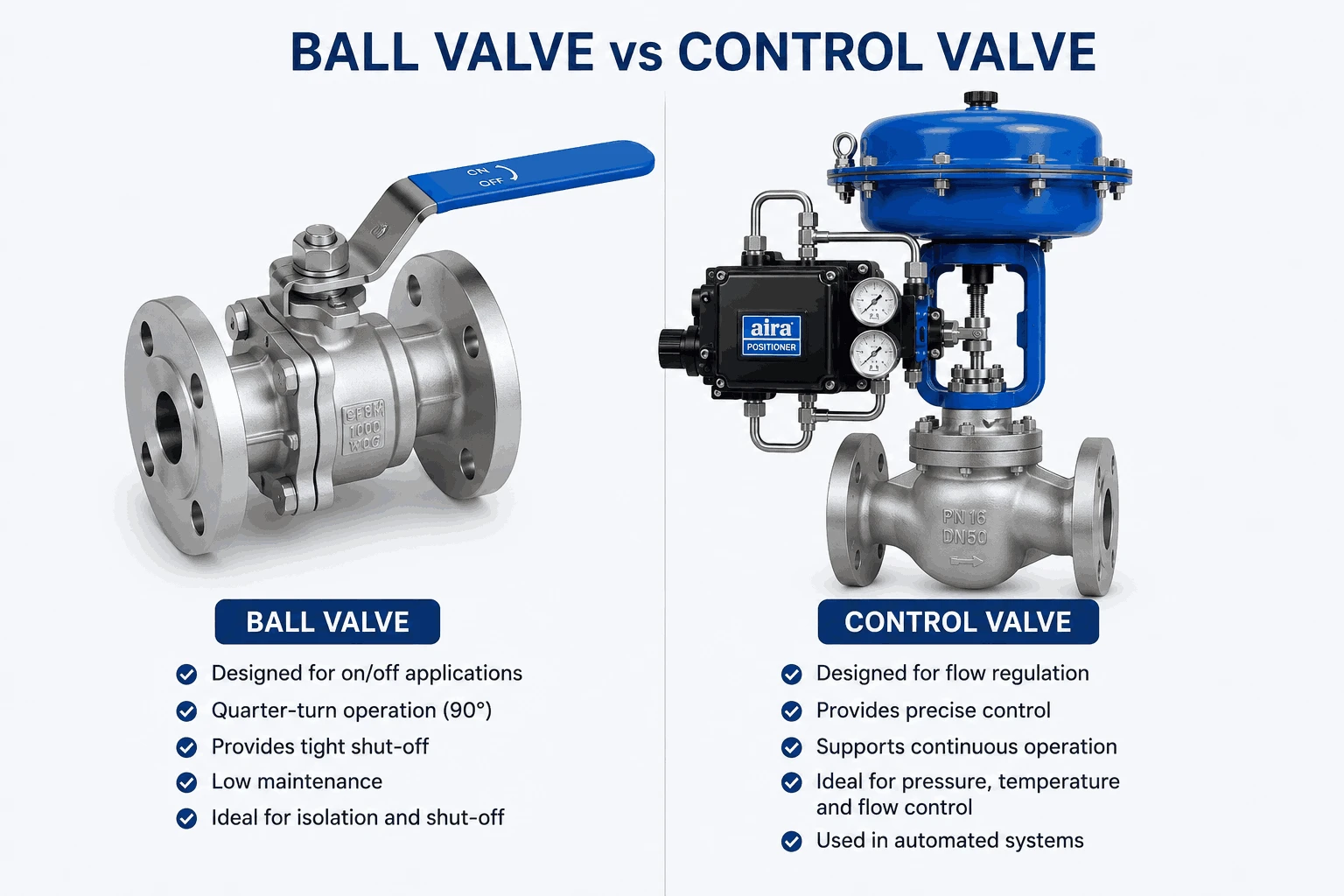
A ball valve consists of a revolving ball with a central passage to regulate the flow.
Fluid flows when the passage is aligned with the pipeline. The flow gets stopped when the ball revolves by 90 degrees.
Ball valves have gained popularity owing to their simplicity in construction and usage, especially when a shut-off function is needed.
Quarter-turn operation
Efficient sealing capacity
Low pressure loss
Increased longevity
Convenient maintenance
Various industries opt for products supplied by a proficient Ball Valve Manufacturer.
Control valves are made for continuous regulation of flow rates rather than on/off control.
Unlike control valves, which only function in fully open or fully closed conditions, control valves provide adjustable flow rates depending on processing needs.
Control valves therefore become very important in applications where there is need for precise regulation of:
Flow rate
Pressure
Temperature
Level of liquids
A good control valve Manufacturer will design their valves for precision in tough industrial situations.
The primary difference lies in how the valve controls flow.
Best suited for start/stop operations
Typically operates fully open or fully closed
Designed for continuous flow regulation
Allows precise adjustment of process conditions
If your application requires accurate control, a control valve generally offers better performance.
Ball valves excel at isolation, while control valves excel at regulation.
Ball valves often have a simpler design, which can make maintenance easier.
Control valves contain additional components that support accurate flow control and may require more regular inspection depending on the application.
Ball valves are often more cost-effective for basic shut-off applications.
Control valves may involve higher initial costs because of their advanced control capabilities.
However, the best choice depends on your operational requirements rather than price alone.
A ball valve may be the right option if you need:
Quick shut-off capability
Reliable isolation
Simple operation
Low maintenance requirements
Minimal pressure loss
Common applications include water systems, compressed air systems, utility services, and general industrial processes.
A control valve is often the better choice when you need:
Precise flow regulation
Automated process control
Pressure management
Temperature control
Continuous process adjustments
Industries that rely on process accuracy often use control valves to maintain stable operating conditions.
Start by understanding your process requirements.
Ask yourself:
Is the valve primarily for shut-off or flow regulation?
What fluid will pass through the valve?
What operating pressures are involved?
What temperatures will the valve experience?
Material compatibility plays a major role in performance and durability.
Common options include:
Stainless steel
Brass
Cast steel
Special alloy materials
The correct material depends on the fluid, operating conditions, and environmental factors.
If you plan to automate your process, consider actuator compatibility from the beginning.
Both ball valves and control valves can be automated, but their operating objectives differ significantly.
Valve quality can vary between suppliers.
When evaluating a Valve Manufacturer, consider:
Product testing procedures
Quality standards
Technical support
Industry experience
Manufacturing capabilities
Many industrial buyers also research a Valve Manufacturer in India when exploring reliable engineering and manufacturing solutions.
When comparing ball valves and control valves, buyers often:
Focus only on price
Ignore application requirements
Select the wrong valve size
Overlook pressure ratings
Choose unsuitable materials
Neglect future automation plans
Avoiding these mistakes can improve reliability and reduce long-term operating costs.
Ball valves are known for their excellent shut-off performance.
Control valves are designed for precise flow regulation.
Ball valves typically operate using a quarter-turn mechanism.
Control valves help maintain stable process conditions.
Correct valve sizing can improve efficiency and system performance.
Material selection significantly affects valve lifespan.
The answer depends entirely on your operational goals.
If your priority is reliable on/off control and isolation, a ball valve is often the preferred choice.
If your process requires accurate control of flow, pressure, or temperature, a control valve is usually the better option.
Understanding your system requirements before purchasing will help you choose a valve that delivers dependable performance over the long term.
Choosing between a ball valve and a control valve is not simply a matter of preference. Each valve serves a specific purpose and performs best under certain operating conditions.
By evaluating your application, flow requirements, operating environment, and automation needs, you can make a more informed decision. Whether you are researching options from a Ball Valve Manufacturer, a control valve Manufacturer, or a trusted Valve Manufacturer in India, focusing on performance and suitability will help ensure long-term value.

I’m Mohammed Kaif, a dedicated writer focused on creating meaningful and reader-friendly content. I enjoy discovering fresh perspectives, simplifying complex ideas, and producing content that informs, inspires, and adds value.
"Which trim do I actually need?" It's a fair question, and one that trips up a lot of first-time buy
7 September 2026
Finishing touches make or break a renovation. You can fit a beautiful new floor or repaint a room pe
4 September 2026
Flat bar trims are one of those quiet building products that rarely get noticed until they're missin
3 September 2026
Be the first to share your thoughts
No comments yet. Be the first to comment!
Share your thoughts and join the discussion below.


.webp&w=3840&q=75)